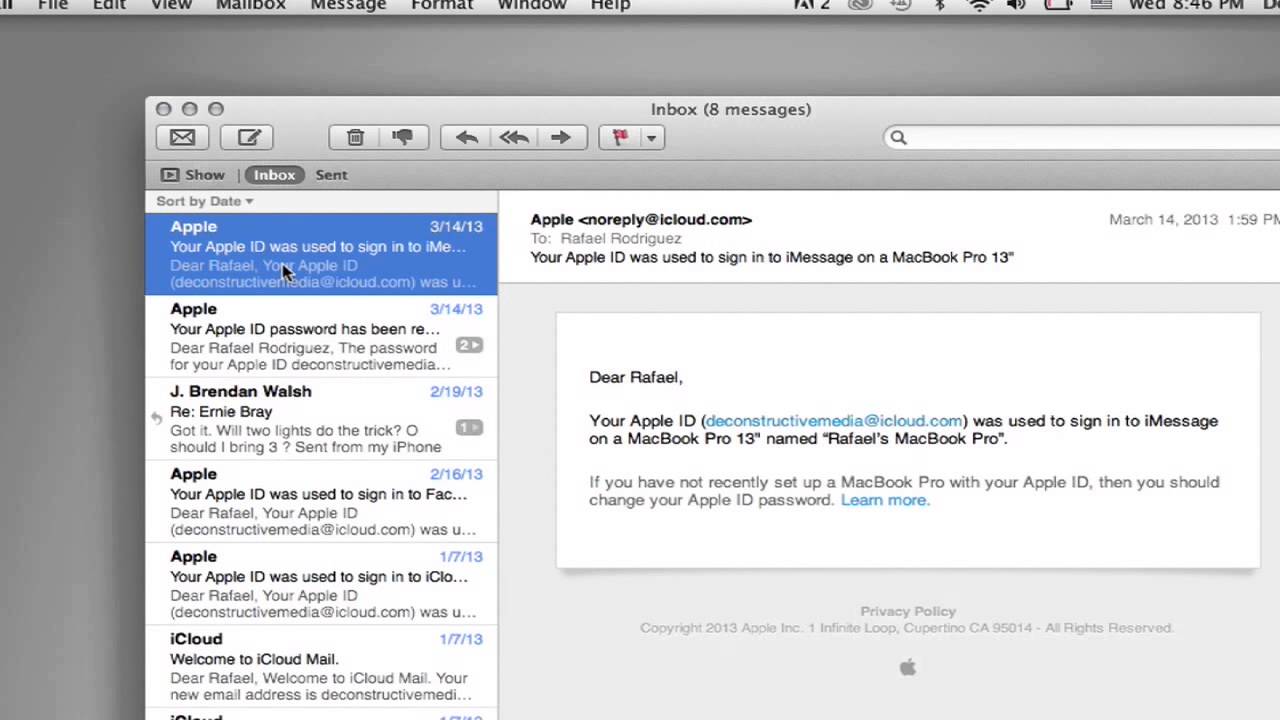
How To Make My Mac Mail Only Store Emails For 1 Year
The developer explains it is incredibly easy for an iOS app maker to recreate the Apple ID password prompt. From there, the app could send that popup and subsequently log the Apple ID and password. It takes less than 30 lines of code and could seemingly be dropped in any legitimate iOS app and sneak past App Store review teams. Showing a dialog that looks just like a system popup is super easy, there is no magic or secret code involved, it’s literally the examples provided in the Apple docs, with a custom text. I decided not to open source the actual popup code, however, note that it’s less than 30 lines of code and every iOS engineer will be able to quickly build their own phishing code. Krause notes how this has been a big problem on, with illegitimate websites sending fake popups that are nearly identical to normal system notifications. It’s largely the same for iOS as well.
I would like to backup all Folders/Mails that are stored locally under »On my Mac« in Mac Outlook 2016. I don’t want to backup the complete Outlook Profile over and over again. Instead only archived messages that are moved to the »On my Mac« section should be backed up. How often Mail downloads your email (from as they arrive to hourly, or manually). How far back to go to get messages (from as short as the last three days to any time). What content you want downloaded (email, calendars, contacts).
He says he’s already filed this issue as a radar with Apple and explains that it could be fixed by Apple not allowing passwords to be entered in popups, but rather only in the Settings app/App Store. As for how you can protect yourself, Krause outlines the following steps: • Hit the home button, and see if the app quits: • If it closes the app, and with it the dialog, then this was a phishing attack • If the dialog and the app are still visible, then it’s a system dialog.  The reason for that is that the system dialogs run on a different process, and not as part of any iOS app. • Don’t enter your credentials into a popup, instead, dismiss it, and open the Settings app manually. This is the same concept, like you should never click on links on emails, but instead open the website manually • If you hit the Cancel button on a dialog, the app still gets access to the content of the password field. Even after entering the first characters, the app probably already has your password. You can read Krause’s full explanation of this.
Mail Inbox, the best unofficial client for Google Inbox, brings Google's idea of the future of email to the Mac. Fitzmaurice Has Text Replacement Shortcuts Update 5/19: Text replacement is available.
May have always been. Two-finger tap inside the reply field, go to Substitutions, put check mark next to Text Replacement. Works like it would in all other apps.
Am very happy to have this feature in my desktop email app, have been waiting for it for a while. Would still like the option to open links in Safari by default, but app is well worth 5 stars even without it. How to link outlook and lync not syncing. ———— Good app, nice to have Inbox on the desktop. Needs two things: support for Text Replacement Shortcuts, and the ability to select what browser to open links in. There is no preferences panel currently, to even offer this as an option. My preference would be for a preference panel.
I’ve only had the app for 5 minutes, but everything else looks pretty good. Have been using Kiwi for the last year or so, but it only supports the non-Inbox variant, so stars on my mac wouldn’t show up on my phone, and pins on my phone wouldn’t show up on my Mac. Looking forward to transcending that pickle. However, links not opening in Safari might prove a bigger issue, Kiwi could do that at least.